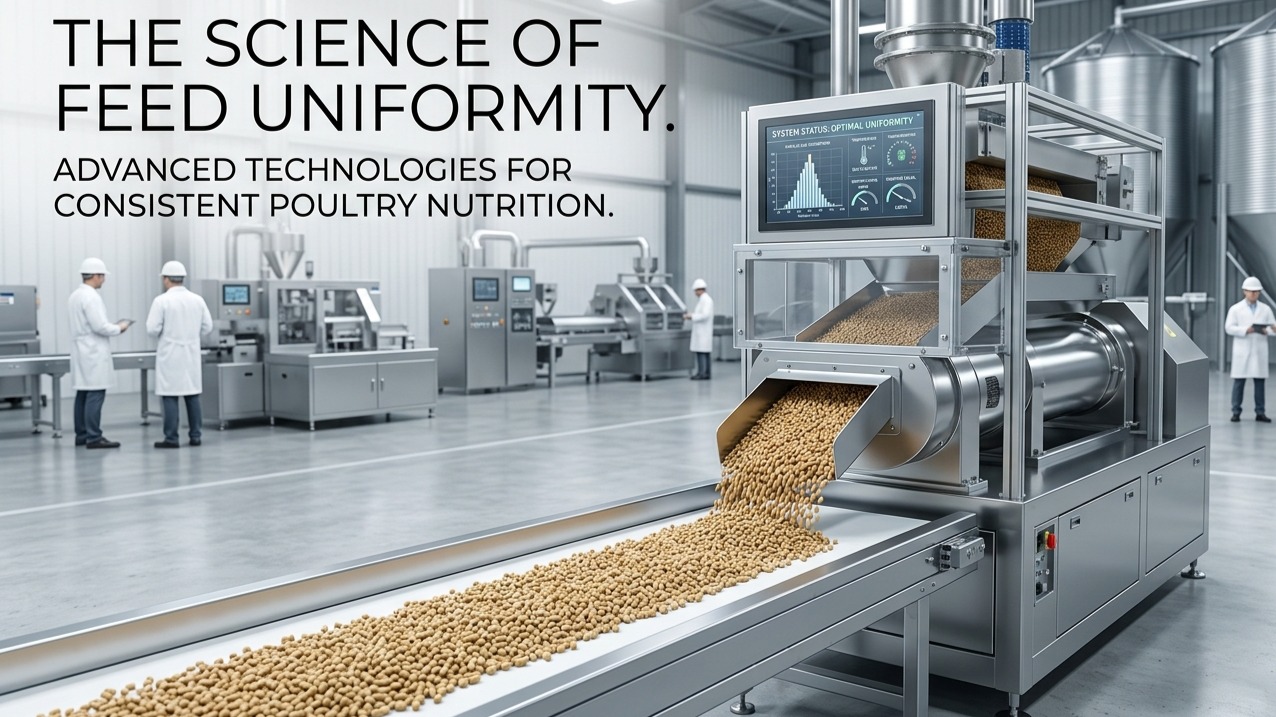
In commercial broiler production, flock uniformity is a principal determinant of processing efficiency and overall profitability. Achieving a highly uniform flock requires that every bird consumes an identical balance of micro and macronutrients. However, when fed a traditional loose mash ration, broilers instinctively exhibit selective feeding behaviors. Utilizing their highly developed visual and tactile senses, birds preferentially consume larger corn particles while leaving behind fine vitamins, minerals, and amino acids. This nutritional segregation leads to uneven growth rates across the house.
To counteract this biological tendency, modern poultry integration relies on advanced feed pelleting technology to enforce structural uniformity.
The Mechanics of Pellet Uniformity
Pelleting converts a finely ground, homogenous mash into dense, free-flowing cylinders. This physical transformation involves a precise thermodynamic process:
- Conditioning: The mash is subjected to pressurized steam, elevating temperatures to between 80°C and 85°C. This heat pasteurizes the feed and initiates starch gelatinization, which acts as a natural binder.
- Compression: The conditioned mash is mechanically forced through a metal die under immense pressure, compacting the nutrients into a unified physical form.
By locking the entire dietary matrix into a single pellet, advanced milling completely eliminates a bird’s ability to sort through its feed. Every single bite delivers a scientifically fixed ratio of proteins, lipids, and trace elements.
Eliminating the Cost of Selective Feeding
From a physiological standpoint, consuming mash is metabolically inefficient. A bird must spend significant time and kinetic energy pecking continuously to satisfy its nutritional requirements. In contrast, pellets allow for rapid prehension. Research demonstrates that broilers fed high-quality pellets spend up to 70% less time eating compared to those on mash, conserving vital metabolic energy that is instead diverted toward skeletal muscle synthesis.
Furthermore, advanced pelleting enhances the
Feed Conversion Ratio (FCR) by drastically reducing physical feed wastage. Loose mash is easily scratched out of feeders into the litter or lost as airborne dust, whereas durable pellets remain intact within the feeding system.
The Standard of Quality
The true success of this technology hinges on pellet durability. If a pellet crumbles easily during transport or distribution, the resulting “fines” reintroduce the risk of selective feeding. Therefore, maintaining strict quality control parameters—such as a high
Pellet Durability Index (PDI)—is a mandatory standard in modern production.
By investing in precision pelleting technologies, manufacturers ensure that scientific formulation translates directly into field performance, securing optimal flock uniformity and predictable economic returns.