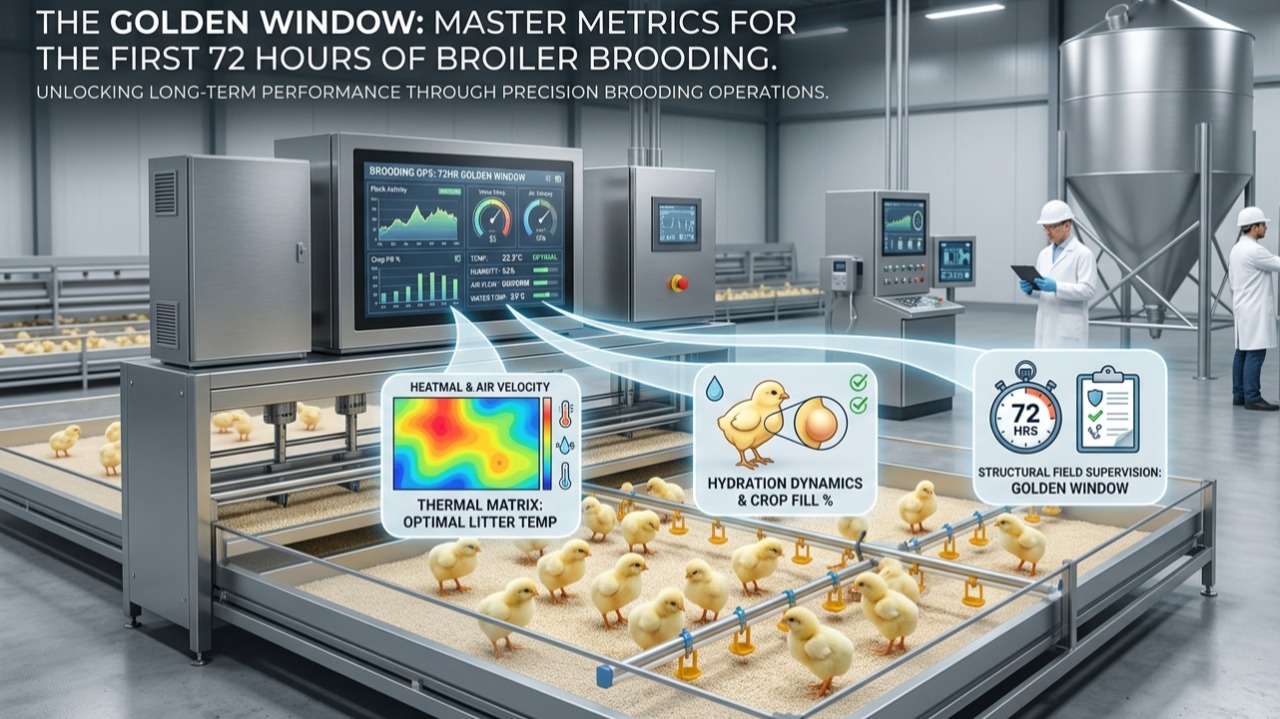
The trajectory of a commercial flock is largely determined during its first three days on the farm. At this stage, day-old chicks are undergoing rapid biological development, shifting from yolk dependence to external feed utilization. Because their internal thermoregulation mechanisms are completely immature, these young birds are entirely vulnerable to environmental stressors. Inadequate management during this initial 72-hour window triggers permanent physiological stunted growth, variable weight distribution, and early mortality.
To anchor a flock for long-term success, production managers must enforce three strict, unyielding operational baselines.
1. Thermal Stabilization
Chicks cannot manage their own body heat; they behave like cold-blooded organisms during week one. For this reason, the house floor temperature must be brought to a stable 32°C to 33°C well ahead of delivery.
If the underlying litter is cold, chicks will quickly lose core heat through conduction. This cold stress causes them to cluster in tight groups for warmth rather than explore the house. Technical field supervisors utilize digital thermal scanners to map the floor, ensuring a completely uniform, draft-free floor temperature that encourages early movement.
2. Hydration Dynamics
While the residual yolk sac provides temporary nourishment, immediate hydration is the absolute catalyst required to ignite the chick’s digestive and metabolic systems. Water lines must be flushed to ensure supply stays clean and cool—ideally near 24°C—as warm water deters drinking.
To verify that the flock is successfully adapting, field teams calculate the Crop Fill Percentage. Within 24 hours of placement, a physical check of random birds should show that 95% of crops feel soft, pliable, and rounded. A hard, distinctly defined crop signals that the chick has eaten feed but failed to drink enough water, while a completely flat crop means it is missing the feeding systems entirely.
3. Structural Field Supervision
Maintaining these precise physical and biological variables across vast production networks is a major logistical challenge. Fully integrated poultry enterprises mitigate this risk by embedding experienced field veterinarians and technical supervisors directly on-site during the critical placement period.
By continuously auditing air flow, monitoring behavioral cues, and maximizing feed accessibility during these first 72 hours, on-ground support teams eliminate early operational gaps. This proactive veterinary oversight ensures excellent initial livability and establishes a uniform foundation for a high-yield harvest.